The best seo keywords for graphic design are not the broadest design terms; they are the phrases that match a real client, a real service, and a page that can answer that need clearly. Start with what you actually sell, add the kind of client or project you want, then decide where each keyword belongs on your site.
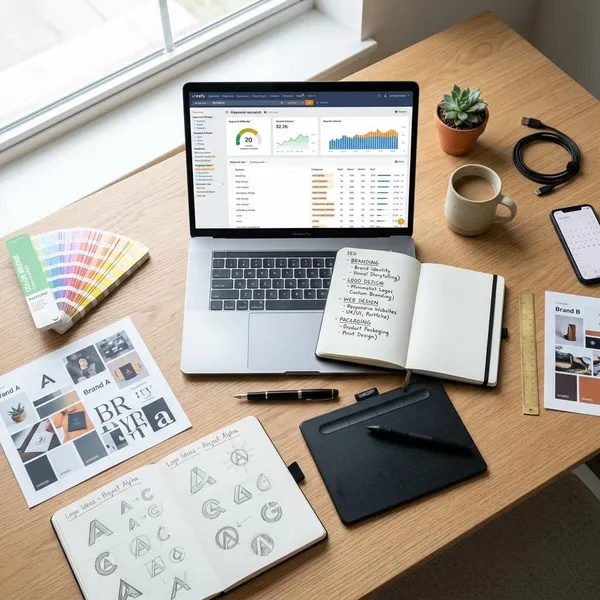
Best Graphic Design Keyword Categories
Graphic design keywords work better when they are grouped by intent instead of collected as one long list. A person searching for a "logo designer for small business" is in a very different place from someone searching for "graphic design inspiration." One may be ready to ask for a quote; the other may only be browsing ideas.
Graphic design services and creative agencies
Broad terms such as "graphic design services," "creative agency," "branding studio," and "visual design services" are useful for your homepage or a main services page. They explain what your business does, but they usually need extra context to convert well.
Logo design and brand identity services
Logo and identity keywords often bring stronger intent because the project is easier to define. Good examples include "logo design services," "brand identity design," "logo and branding package," and "custom logo designer."
- Use a logo page if you mainly sell standalone logo work.
- Use a brand identity page if the offer includes colors, typography, guidelines, and rollout assets.
- Avoid mixing both loosely if your pricing, process, or deliverables are very different.
Print design and digital illustration
Print and illustration terms are useful because they usually point to a specific deliverable: menu design, packaging design, brochure design, poster design, book cover illustration, presentation design, or social media graphics. These searches are often practical, not theoretical.
Freelance designers and designers for hire
Keywords such as "freelance graphic designer," "graphic designer for hire," "contract graphic designer," and "remote graphic designer" attract people comparing flexible help with a larger agency. These can be valuable if you handle one-off projects, overflow work, or monthly design support.
Make the working arrangement clear. Someone hiring a freelancer usually wants to know availability, turnaround style, communication, and whether you can work with an existing brand system.
Local graphic design services
Local searches like "graphic designer in Chicago," "logo design near me," or "branding agency in Austin" can bring qualified leads when location matters. They are especially useful for designers who meet clients locally, serve a defined region, or rely on local referrals.
Small business and industry-specific design
Small business and industry keywords often bring fewer searches but better-fit leads. Phrases like "logo design for small business," "restaurant menu designer," "real estate brochure design," and "healthcare branding designer" tell you who the client is and what they need.
This is where many designers can compete without chasing huge generic terms. If you understand a niche, use that knowledge: a salon, nonprofit, law firm, ecommerce brand, and fitness studio will not judge design work in exactly the same way.
Which Keywords Attract Qualified Leads?
The most qualified keywords usually combine a design service with a buying signal. That signal might be a deliverable, client type, industry, location, price question, or hiring phrase. If a keyword tells you what the person needs and why they need it, it is usually more useful than a broad high-volume term.

| Search pattern | What it usually means | Best page type |
|---|---|---|
| Service + deliverable | The client knows the output they need | Service or portfolio page |
| Service + industry | The client wants relevant experience | Niche service page or case study |
| Service + location | The client prefers a nearby or market-aware provider | Location page |
| Cost or quote phrase | The client is comparing budget and fit | Pricing page, FAQ, or blog post |
How to Choose the Right Keywords
Choose keywords by starting with your business, not with a keyword tool. A phrase is only worth targeting if it matches a service you want to sell, a client you want more of, and a page you can make genuinely useful.
List your main design services
Write down the services clients can actually buy from you: logo design, brand identity, packaging, brochure design, menu design, presentation design, illustration, social graphics, print layout, or ongoing design support.
Then separate broad services from specific deliverables. "Graphic design" may describe your work, but "restaurant menu design" or "pitch deck design for startups" is much easier to turn into a focused page.
Define your ideal clients
A keyword that attracts the wrong buyer is not a win. Decide whether you want startups, local businesses, ecommerce brands, nonprofits, agencies needing overflow support, or established companies with recurring design needs.
- If you want bigger projects, avoid building your whole strategy around "cheap logo" or "quick logo" searches.
- If you want recurring work, include terms around retainers, monthly design support, or marketing design services.
- If you want niche clients, combine the service with the industry instead of chasing broad traffic.
Add industry and location modifiers
Modifiers make broad keywords more targeted. Add industries you know well, such as hospitality, beauty, real estate, healthcare, legal, construction, coaching, or ecommerce. Add city or region terms only where they reflect a real market you serve.
A narrow phrase like "branding designer for salons in Los Angeles" may not bring huge traffic, but it tells you much more about the buyer than "design help." That makes it easier to write a page that feels relevant.
Review the current search results
Search the keyword before you commit to it. If the top results are service pages, local packs, and agency pages, a commercial page may fit. If the results are tutorials, inspiration galleries, or definitions, a blog post is usually a better match.
Compare relevance, demand, and competition
Relevance comes first. A lower-volume keyword that fits your best service can be more valuable than a popular keyword that attracts students, job seekers, or casual browsers.
Use demand and competition as filters, not as the whole decision. If you can create a stronger, more specific page than what currently ranks, the keyword may be worth targeting even if the search volume looks modest.
Group close variants together
Do not create separate pages for every small wording change. "Logo design services," "custom logo design," and "logo designer for small business" can often live on one well-built logo page if the intent is similar.
Split keywords only when the searcher wants something different. "Graphic design pricing," "graphic design portfolio," and "hire a graphic designer" should usually lead to different page types because they answer different questions.
Where Should Each Keyword Go?
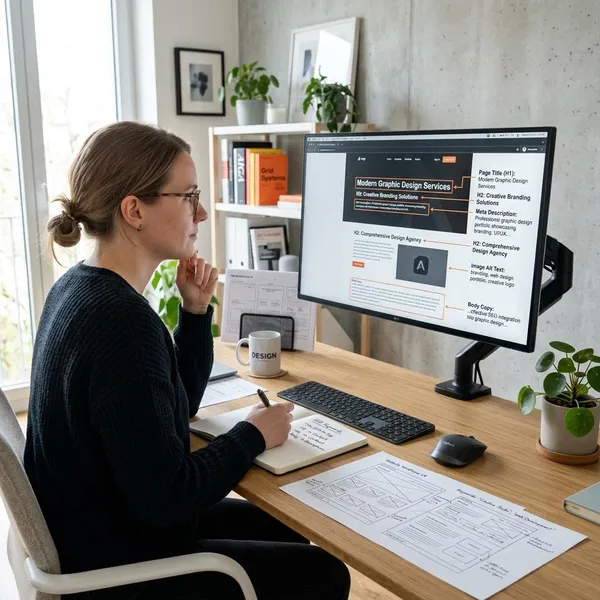
A keyword map keeps your site from turning into a pile of competing pages. Give each important keyword a clear home, then use close variants naturally on that same page instead of repeating the same target across your whole site.
Core services on the homepage
Your homepage should target broad terms that describe your business as a whole, such as "graphic design services," "branding studio," "creative agency," or "freelance graphic designer." It should also point visitors toward the more specific pages that match their need.
Do not make the homepage carry every niche keyword. Its job is to give a quick sense of fit: what you do, who you help, and where someone should click next.
One service cluster on each service page
Each service page should focus on one main cluster. A logo page can include "logo design services," "custom logo design," and "logo designer for small business." A packaging page can include "packaging design services," "product packaging designer," and close variants.
This keeps the page focused for both search engines and buyers. Someone looking for brochure design should not have to scroll through a long branding page to find the offer they searched for.
Local terms on location pages
Use location pages for city or regional searches such as "graphic designer in Seattle" or "branding agency in Manchester." A good location page should include relevant services, the kind of local clients you serve, and proof where you have it.
Mass-producing near-identical city pages is not a strong strategy. If you cannot add useful local context, it may be better to focus on fewer locations and make those pages stronger.
Project terms on portfolio pages
Portfolio pages can capture long-tail searches when the projects are named and described clearly. Use titles like "restaurant menu design," "beauty packaging design," or "real estate brochure design" instead of vague project names.
- Add the goal: what the client needed.
- Name the deliverables: logo, packaging, brochure, signage, or digital assets.
- Include a next step: link to the related service or contact page.
Client problems on case studies
Case studies are useful for problem-based searches such as "rebrand outdated logo," "improve packaging design for retail," or "design marketing materials for event launch." They let you show how you think, not just what the finished work looks like.
Keep the structure practical: the problem, the approach, the deliverables, and the result. Avoid vague claims if you cannot support them; clear context is more believable than inflated outcomes.
Informational terms on blog posts
Blog posts are the right home for questions such as "how much does logo design cost," "what is included in brand identity design," "best brochure sizes for print," or "how to choose a packaging designer." These searches may be earlier in the buying journey, but they can still lead to good inquiries.
The blog should support your service pages, not replace them. Answer the question honestly, then link to the relevant service, portfolio example, or contact option when it fits naturally.
Conclusion
A strong keyword plan for a design business is usually smaller and sharper than a giant spreadsheet. Put your best effort into phrases that match your services, your preferred clients, and the right page type; skip keywords that would bring work you do not want or cannot prove well. That is how search traffic becomes better inquiries instead of just more visitors.